


BY OSABUOHIEN VIVIAN ROSE
The Trump administration said Friday it would ask companies to pay $100,000 yearly for H-1B worker visas, prompting some big tech companies to warn visa holders to stay in the U.S. or return immediately.
The change could deal a big blow to the technology sector which relies mainly on skilled workers from India and China.
After begin second tenure since January, Trump has kicked off immigration crackdown, including ways to reduce some forms of legal immigration. The step to reshape the H-1B visa program represents his administration’s most high-profile effort yet to rework temporary employment visas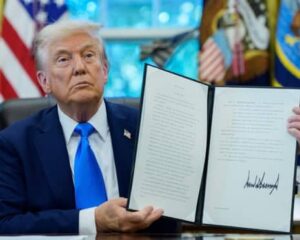 .If you’re going to train somebody, you’re going to train one of the recent graduates from one of the great universities across our land,” said Commerce Secretary Howard Lutnick. Train Americans. Stop bringing in people to take our jobs.”
Trump’s threat to crack down on H-1B visas has become a major flashpoint with the tech industry, which contributed millions of dollars to his presidential campaign.
Microsoft (MSFT.O), JPMorgan (JPM.N), and Amazon (AMZN.O), responded to the announcement by advising employees holding H-1B visas to remain in the United States, according to internal emails, Reuters reported.
They advised employees on the H-1B visas who were outside the U.S. to return before midnight on Saturday (0400 GMT on Sunday), when the new fee structures are set to take effect.
“H-1B visa holders who are currently in the U.S. should remain in the U.S. and avoid international travel until the government issues clear travel guidance,” read an email sent to JPMorgan employees by Ogletree Deakins, a company that handles visa applications for the U.S. investment bank.
Some employers have exploited the program to hold down wages, disadvantaging U.S. workers, according to the executive order Trump signed on Friday.
The number of foreign science, technology, engineering and mathematics (STEM) workers in the U.S. more than doubled between 2000 and 2019 to nearly 2.5 million, even as overall STEM employment only increased 44.5% during that time, it said.
Under the current system, entering the lottery for the visa requires a small fee and, if approved, subsequent fees could amount to several thousand dollars.
Some analysts suggested the fee may force companies to move some high-value work overseas, hampering America’s position in the high-stakes artificial intelligence race with China.
“In the short term, Washington may collect a windfall; in the long term, the U.S. risks taxing away its innovation edge, trading dynamism for short-sighted protectionism,” said eMarketer analyst Jeremy Goldman.
India was the largest beneficiary of H-1B visas last year, accounting for 71% of approved beneficiaries, while China was a distant second at 11.7%, according to government data.
The H-1B program offers 65,000 visas annually to employers bringing in temporary foreign workers in specialized fields, with another 20,000 visas for workers with advanced degrees.
Nearly all the visa fees have to be paid by the employers. The H-1B visas are approved for a period of three to six years.
Trump also signed an executive order on Friday to create a “gold card” for individuals who can afford to pay $1 million for U.S. permanent residency.
