


BY OSABUOHIEN VIVIAN ROSE
Thousands of people appear to have fled the central Syrian city of Homs Thursday night into Friday, as anti-regime rebels push further south on the road to the capital Damascus.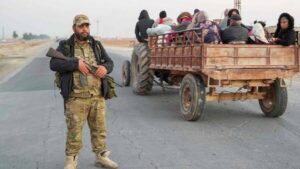
Videos from Thursday night into Friday showed hundreds of vehicles plying the highway out of Homs, as the city braces for violence that may come during clashes between the rebels and the regime.
After capturing the city of Hama to the north on Thursday, the rebels set their sights on the crossroads city of Homs which, if captured, would split the territories under the control of President Bashar al-Assad in two.
The main aim of Syria’s rebel coalition, which has wrested two major cities from government control in just over a week of fighting, is to overthrow the decades-old Assad regime, the militant leader of the rebels, Abu Mohammad al-Jolani, told CNN.
“When we talk about objectives, the goal of the revolution remains the overthrow of this regime. It is our right to use all available means to achieve that goal,” said Jolani.
Homs has a sizeable population of Alawites, co-religionists of Assad, many of whom fear retribution from Islamist militants who accuse Alawites of dominating the country and supporting Assad’s quashing of the rebellion.
After bursting out of their pocket of territory in the northwest region of Idlib, the rebels captured the Aleppo and Hama within three and eight days respectively, with no much resistance from regime forces which were caught flat-footed by the lightning offensive.
It is not clear whether regime forces will be able to defend the city of Homs, about an hour’s drive south of Hama. If the rebels next capture Homs, this would mean they have effectively spliced the Assad regime into two pockets: one along the coast and the other in Damascus.
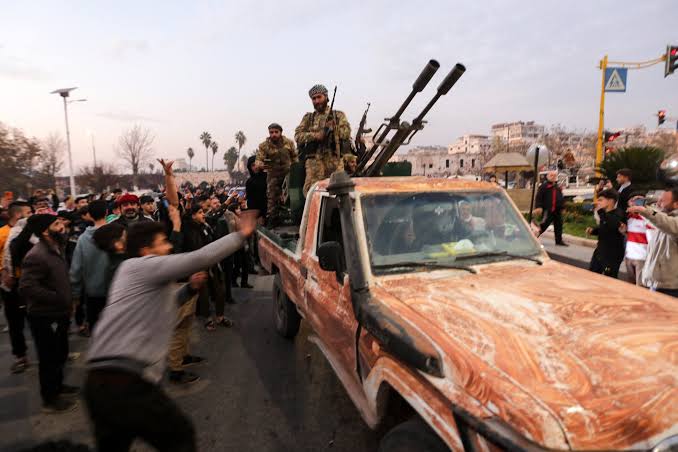
The rebels’ progress has been met with celebration from many residents of the newly captured towns and cities who had lived under regime rule for years.
The rebels, led by the Islamist group Hayat Tahrir al-Sham (HTS), said they freed hundreds of those “wrongfully detained” from Hama’s central prison. The city was the site of one of Syria’s largest massacres in 1982, when President Hafez al-Assad – father of the present leader – ordered his military to quash a revolt.
Jolani, the leader of HTS, said his group aimed to create a government based on institutions and a “council chosen by the people.”
The offensive has reawakened a civil war that had been stalemate for years. The fight started in 2011, after Assad moved to stamp out peaceful pro-democracy protests during the Arab Spring. The fighting swelled as other regional actors and world powers – from Saudi Arabia and the United States to Iran and Russia – piled in, escalating the civil war into what some observers described as a “proxy war.”
Over 300,000 civilians have been killed in the 13-year-old war, according to the United Nations, with millions of people displaced.
The city of Homs, parts of which were controlled by insurgents until 2014, is a major intersection point between Damascus, and Syria’s coastal provinces of Latakia and Tartus where Assad enjoys wide support. Homs province is Syria’s largest in size and borders Lebanon, Iraq and Jordan.
