



BY OSABUOHIEN VIVIAN ROSE
Millions of Filipinos showed their devotion to Jesus Nazareno as they participated in the second post-pandemic Traslacion this year.

The procession, which started at around 4:40 a.m. Thursday, reached the Minor Basilica and National Shrine of Jesus Nazareno in Quiapo, Manila at around 1:25 a.m. early Friday, after almost 21 hours.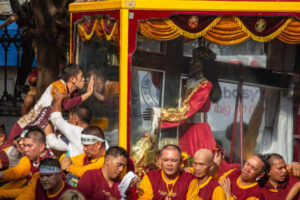
Unlike last year’s procession, this year’s Traslacion was not so smooth, with the crowds slowing down the movement of the carriage or andas as early as 5 a.m.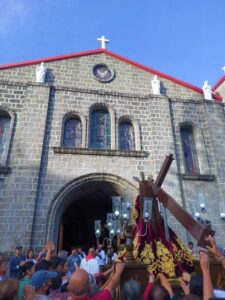

At around 5:20 a.m., the flow of the andas paused right at the center of Roxas Boulevard because of the intense movement of devotees who were trying to go near the image of Jesus Nazareno before it moved forward to Padre Burgos Street.
BY 7:27am, the andas was stuck at Padre Burgos Street for more than an hour before it arrived in front of the National Museum of Anthropology.
Local authorities confirmed one of the ropes used to pull the carriage snapped, causing it to lose balance, which also caused the procession to slow down.
The second rope of the andas also snapped near San Sebastian Church, according to the Nazareno Operations Center. Without the ropes, the carriage had to be pushed instead.
The andas reached the the Plaza del Carmen at the San Sebastian Church before 6 p.m. for the traditional “Dungaw”, which honors each patron of the churches.
Despite a ban on riding the andas, authorities were not able to stop many devotees from climbing onto the carriage.
The force from the devotees seemingly slowed the flow of the massive procession in Manila.
The new andas design was also unable to stop devotees from climbing, as some of them forced their way to touch the tip of the cross or the glass covering the image.
Early in the procession, some devotees were injured and required medical assistance.
Other devotees who were attended to by emergency responders included those who were elbowed aside and those who suffered splinters.
Volunteers of various emergency medical services said they usually attend to bare-footed devotees who reported minor wounds, cuts, and difficulty in breathing.
Some devotees injured in early hours of Traslacion 2025.
Despite the risks, devotees show up to continue their “panata” to the the centuries-old image of the Jesus Nazareno, believed to have healing and wish-fulfillment powers.
The “panata” is a personal one, ranging from serving food to others walking the Traslacion or trooping to the Minor Basilica and National Shrine of Jesus Nazareno all the way to the riskier ones, climbing the andas or carriage which carries the image or holding the 50-meter-long rope that pulls it.
Fulfilling one’s “panata” for the Nazareno, however, has been proven dangerous. As the procession grew in popularity, so also the number of people who troop to Manila to partake in the event. Organizers have long put measures to deter devotees from climbing the andas.
Nazareno devotees continue their ‘panata’ despite risks to safety
Many of the devotees also join the procession barefoot.
Men and women in maroon shirts, the color of the robe that covers the black, wooden Jesus Nazareno statue, rush to grab the rope used to draw the life-sized religious icon, believing it would bring good health.
Some faithful threw white towels to worshippers tasked with guarding the float, hoping God’s blessings might rub off on the cloths used to clean the statue’s glass case.
As of 12:19 a.m., the National Disaster Risk Reduction and Management Council (NDRRMC) placed the cumulative crowd estimate at over 7.9 million, with over 6.3 million people in Quiapo.
As of 12:45 a.m., the carriage is at Villalobos Street, over 20 hours after the procession started.


