



BY OSABUOHIEN VIVIAN ROSE
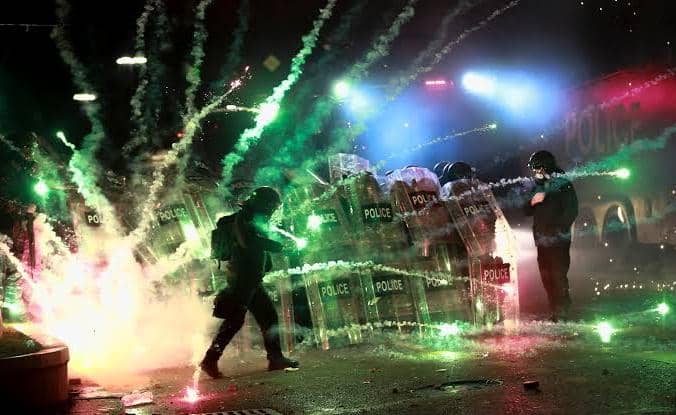
More than 107 people were arrested during Friday’s protests in the capital Tbilisi, Georgia’s interior ministry said.
This was prompted by the government’s decision to delay the former Soviet country’s bid to join the European Union.

The Black Sea nation has been rocked by demonstrations since Thursday, when the ruling Georgian Dream party, which won in last month’s election that observers said was fraudulent, announced it would suspend accession talks with the EU until 2028.
“Throughout the night, protesters confronted police verbally and physically,” the ministry said in a statement on Saturday. “Activists… threw various objects, stones, pyrotechnics, glass bottles and iron objects in the direction of law enforcement officers,” it said, adding that 10 ministry employees had been injured.
Video taken by Reuters showed thousands of people taking to the streets, waving Georgian and EU flags as they marched. Demonstrators were heard chanting “Russian slaves” at police officers guarding the parliament building. Police fired water cannons and tear gas at protesters, while men wearing balaclavas were seen running into the crowds and beating individuals.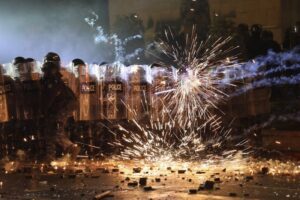

Salome Zourabichvili, the country’s pro-Western president whose powers are mostly ceremonial, claimed that the police “targeted journalists and political leaders.”
“It is Europe and the European ideal that these Russian proxies are deliberately and savagely crushing on the Tbilisi streets. Wake up Europe!” she wrote on X Saturday.
She also posted videos of the rallies, claiming that twice the number of protesters were demonstrating on Friday night than Thursday.
“It’s evident in every way – no one is willing to accept a Russified Georgia, a Georgia deprived of its constitution, or a Georgia under an illegitimate government and parliament,” Zourabichvili wrote on X Friday. “That’s why so many of you are out here today – I see you.”
Georgian public broadcaster First Channel reported on Friday protesters had set fire to wiring on the country’s parliament building and thrown objects at police officers. It also reported that police were firing water cannons at protesters, though said the demonstrators regrouped each time a water cannon was fired.
Zourabichvili condemned what she called “brutal and disproportionate attacks on the Georgian people and media, reminiscent of Russian-style repression” at the protests.
“These actions will not be forgiven! Those responsible for the use of force should be held responsible,” she said.
The protests are part of the ongoing fallout from the country’s October 26 parliamentary election, which was seen as a referendum on alignment with Russia or the West. After years of moving closer towards Europe – and securing EU candidate status late last year – Georgian Dream has taken a sharp authoritarian turn. In May, it forced through a Kremlin-style “foreign agent” law, which critics say aims to shut down watchdogs who call the government to account.
The party won almost 54% in the parliamentary election, but opponents claim Russia helped rig the vote to halt the country’s move towards the West.
There were allegations of ballot box stuffing, intimidation and civil servants being forced to vote for the status quo.
The European Parliament rejected the outcome of the election on Thursday and called for a re-run to be held within a year. It said the vote was “neither free nor fair” and was another instance of democratic backsliding in Georgia, “for which the ruling Georgian Dream party is fully responsible.”
Hours later, Georgian Prime Minister Irakli Kobakhidze said his government would remove EU talks from its agenda and refuse the bloc’s budgetary grants until 2028, accusing some of the bloc’s politicians of “blackmail and manipulation.”
During the election campaign, Georgian Dream repeatedly assured voters it was committed to pursuing EU membership, which polls show more than 80% of Georgians support.
Protesters in Tbilisi said that, while many doubted the sincerity of Georgian Dream’s commitment to joining the EU, they were shocked that it changed its course so soon after the disputed election.
A non-resident fellow with the Democratic Resilience Program at the Center for European Policy Analysis (CEPA), Ketevan Chachava, said she was surprised the mask had dropped so quickly.
Salome Khvaratskelia, a nurse, said the police had used new equipment to disperse the crowds. Shortly before the election, Georgia’s interior minister announced the government had purchased several new water cannons to bolster the riot police.
Tbilisi has been regularly gripped by protests in recent years in response to moves by Georgian Dream, particularly over the “foreign agent” law, which critics say was a copy of legislation passed by Russian President Vladimir Putin.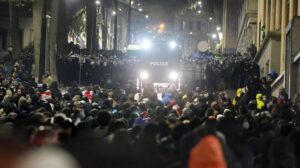

But the government’s stoppage of the country’s EU membership bid appears to have ignited the protest movement.


