


 Bangladesh PM Sheikh Hasina Flees To India, Interim Government To Be Formed, Says Army
By
OSABUOHIEN VIVIAN ROSE
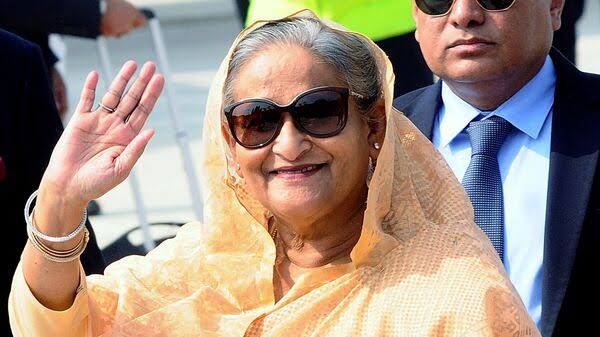
Bangladesh Prime Minister Sheikh Hasina has resigned and fled the country Monday after hundreds of people were killed in a crackdown on demonstrations that began as protests against job quotas and rose into a movement demanding her stepping down.
Jubilant crowds stormed into the opulent grounds of the presidential residence unopposed, carrying out looted furniture and TVs.
Protesters climbed atop a statue of Hasina’s father, state founder Sheikh Mujibur Rahman, and began chiselling away at the head with an axe in Dhaka.
The flight into exile ended a 15-year second stint in power for Hasina, who has ruled for 20 of the last 30 years as leader of the political movement inherited from her father, assassinated with most of his family in a 1975 coup.
Hasina left the country for her own safety at the insistence of her family, her son Sajeeb Wazed Joy revealed to BBC World Service.
Hasina was “so disappointed that after all her hard work, for a minority to rise up against her”, Joy said.
She would not attempt to mount a political comeback, he said.
Earlier, army chief General Waker-Uz-Zaman announced Hasina’s resignation in a televised address to the nation and said an interim government would be formed.
He said he had held talks with leaders of major political parties – excluding Hasina’s long-ruling Awami League – and would soon meet President Mohammed Shahabuddin to discuss the way ahead.
The 76-year-old leader was reported to have landed at a military airfield near Delhi, though could not be verified by reports but commercial tracking services showed a Bangladesh Air Force plane had left the country and flown west before disappearing from tracking near Delhi.
Regarding sources, ANI reported that India’s National Security Adviser Ajit Doval and senior military officers met Hasina at the airfield and she was being moved to a safe location.
Bangladesh has been engulfed by violence since student protests last month against the quotas, which reserve some public sector jobs for veterans of the country’s 1971 war of independence from Pakistan, seen as favouring allies of the ruling party.
The protests escalated into a campaign demanding the overthrow of Hasina, and were met by a violent crackdown in which about 250 people have been killed and thousands injured.
The country, once one of the fastest-growing economies in world, has been plagued lately by slow economic growth, inflation and unemployment.
Hasina had ruled since winning a decades-long power struggle with Zia in 2009. The two women each inherited political movements from slain rulers – in Hasina’s case, from her father Mujib; in Zia’s case, from her husband Ziaur Rahman, who took power after Mujib’s death and was himself assassinated in 1981.
“Hasina’s resignation proves the power of the people,” said Tarique Rahman, the exiled eldest son of the two Zias who now serves as acting chairman of the oppposition party.
“Together, let’s rebuild Bangladesh into a democratic and developed nation, where the rights and freedoms of all people are protected,” he posted on X.
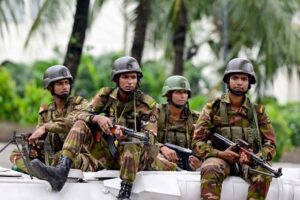
Student activists had called for a march to the capital Dhaka on Monday in defiance of a nationwide curfew to press Hasina to resign after clashes across the country on Sunday killed nearly 100 people.
Last month, at least 150 people were killed and thousands injured in violence by student groups protesting against the job quotas.
The government declared the indefinite nationwide curfew starting at 6 p.m. (1200 GMT) Sunday and also announced a three-day general holiday starting from Monday.
Over the weekend, there were attacks, vandalism and arson targeting government buildings, offices of Hasina’s Awami League party, police stations and houses of public representatives.
Garment factories in Bangladesh, which supply clothings to some of world’s top brands, were closed indefinitely.
