


Spain Flood Deaths Rises To 205 As Rescue Workers Continue Search
By
OSABUOHIEN VIVIAN ROSE
At least 500 soldiers were deployed to Valencia to search for people who are still missing and help survivors of the storm, which triggered a fresh weather alert in Huelva in southwestern Spain..
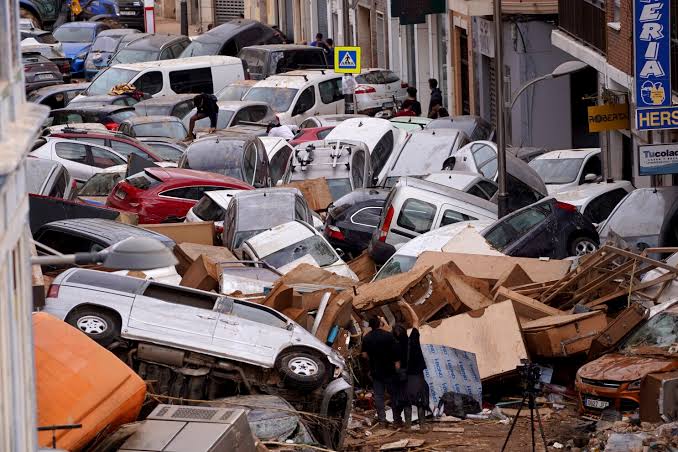
Spanish rescuers have opened a temporary morgue in a convention centre and battled to reach areas still cut off as the death toll from devastating floods rose to 205 people in Europe’s worst weather disaster in five decades.
Officials have said the death toll is likely to keep rising.

It is already Spain’s worst flood-related disaster in modern history and the deadliest to hit Europe since the 1970s.
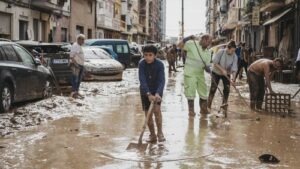
“It’s all destroyed, shops, supermarkets, schools, cars,” said local resident Patricia Villar.
Emergency services working to clear cars piled up at the entrance of a flooded underpass in the suburb feared finding more trapped bodies.
“We’re trying to remove vehicles bit by bit to see if there are victims,” one rescue worker told state television.

“We don’t know,” the rescue worker added.
With about 75,000 homes still without electricity, firefighters were siphoning petrol from cars that had been abandoned in the floods to power generators to get domestic supplies back on.
“We’re going from car to car looking for any petrol we can find,” said one firefighter who had travelled to Valencia from the southern region of Andalusia to assist rescue efforts, carrying a plastic tube and empty bottles to collect the petrol from the cars’ tanks.
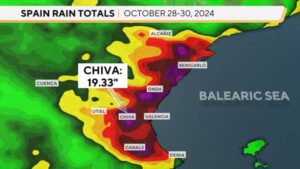
A year’s rain fell in just eight hours Tuesday night, destroying roads, railway tracks and bridges as rivers burst their banks.
The flooding also submerged thousands of hectares of farmland in the region, which produces nearly two-thirds of citrus fruit in Spain – the world’s top exporter of oranges.
“The magnitude of the catastrophe has no precedent,” Transport Minister Oscar Puente told local television.
While the waters have subsided in most parts of Valencia, emergency services have still not been able to reach a few areas due to blocked roads.
They included Albal, a neighbourhood close to Alfafar, one resident said.
Residents in the Valencia suburb of Paiporta were taking turns to guard shops after authorities said 50 people had been arrested for looting and they were running low of drinking water.
As the death toll rose, a temporary morgue was set up at the Feria Valencia convention centre on the outskirts of Valencia city, emergency services said, and the first bodies started to arrive this morning.
It comes as the Spanish authorities issued the highest weather warning for the country’s southwestern coast as the storms which have devastated the Valencia region to the east continue to threaten lives and communities.
The town of Huelva, as well as other municipalities, have already been flooded this morning.
In the early hours, nearby towns recorded 100 litres of water per square metre.
The agency has also issued orange alerts for the islands of Mallorca and Menorca, as well as for the northern coast and northern interior.
As Spain faces into a holiday weekend, the authorities have urged people not to travel to the Balearic islands, Catalonia, Andalusia, Valencia or Extremadura.
Meanwhile, Ireland’s President Michael D Higgins wrote to King Felipe of Spain, expressing his deepest sympathy following the floods.
He said that Ireland mourns with Spain and offers its unwavering support.
In a letter, Mr Higgins said: “May I, on behalf of the people of Ireland, extend deepest sympathies to you and to the people of Spain in the wake of the devastating floods that have caused such loss of life and immense suffering.
“Ireland stands in solidarity with Spain during this difficult time, and our thoughts are with all of those affected as they face the daunting task of recovery.
“Ireland mourns with Spain, we share in your grief, and offer our unwavering support and any assistance we can offer for the process of rebuilding and recovery.”
Last night, Taoiseach Simon Harris spoke to the Spanish Prime Minister Pedro Sanchez, expressing Ireland’s horror and sorrow at the numbers of people who had lost their lives in the disaster.
While the people of Valencia continue to count the cost of the devastating flash floods earlier this week, the Spanish meteorological agency has issued a red alert for the province of Huelva, next to the Portuguese border on the southwestern coast.
J
Scientists link it to climate change, which is also behind increasingly high temperatures and droughts in Spain and the heating up of the Mediterranean Sea.
Human-caused climate change has doubled the likelihood of a storm like this week’s deluge in Valencia, according to a rapid but partial analysis by World Weather Attribution, comprising dozens of international scientists who study global warming’s role in extreme weather.
Spain has suffered through an almost two-year drought, meaning that when the deluge happened, the ground was so hard that it could not absorb the rain, leading to flash floods.
Spain’s national weather service said it rained more in eight hours in the Valencian town of Chiva than it had in the preceding 20 months.
Greenhouses and farms across southern Spain, known as Europe’s garden due to its export produce, were also ruined by heavy rains and flooding.
In August 1996, a flood swept away a campsite along the Gallego river in Biescas, in the northeast, killing 87 people.
